DIY Card Model Animals
I'm all ears because I heard you want to build a model of me. What
great taste you have!
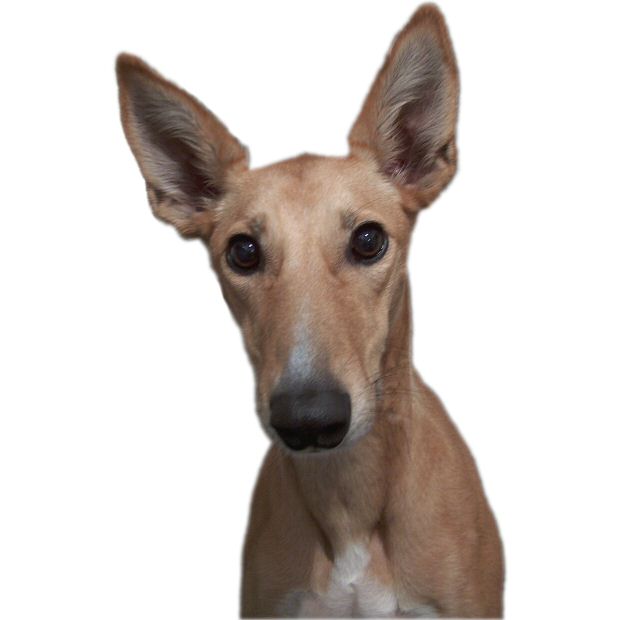
Hi, I'm Shipyard the lurcher - a curious nickname I must confess, but
I do live by the seaside and I am a bit of a salty old sea-dog. At the
bottom of this page is a pdf model of me that you can download and print
out on 160gsm card.
Despite the fact that lurchers make the best subjects (my unbiased
opinion) I realize that there may be other creatures in your affections
and for that reason this page also contains information on how to create
your own Do-It-Yourself (DIY) card model animal.
So why not have a go at building me, then when you've got the idea,
have a go at creating your own.

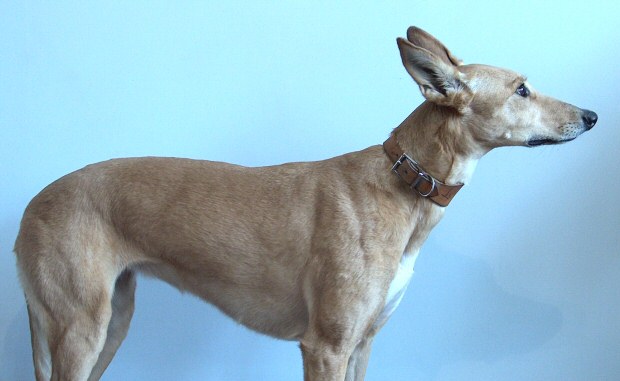
To create your DIY animal, perhaps a model of a pet, you first need
a side-view photo of your subject. We used a plain painted wall as a
backdrop to photograph our lurcher who dutifully stood still for the
task.
If you don't have a pet then try searching for suitable images in books,
magazines or on the internet.
The principle behind the model is basically to fold an outline of the
animal in half along its spine. Of course it's very unlikely for an
animal to have a perfectly straight backbone, so this needs to be represented
by a series of straight lines that approximate a curved spine.
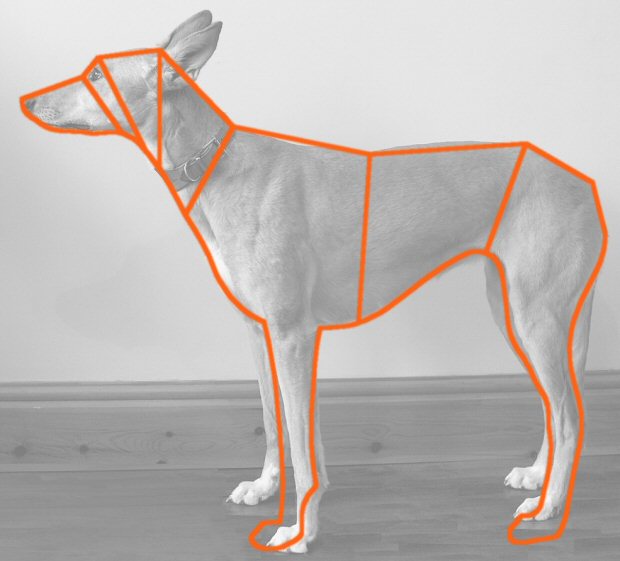
Trace the outline of the animal accurately and create the spine using
a series of straight lines.
Next, the traced outline of the animal is divided into sections by
drawing a straight line from each apex (line intersection) on the spine.
The lines drawn should bisect the backbone angles roughly in half, although
really it's just a matter of judging what looks good. Our lurcher was
divided up into seven sections.
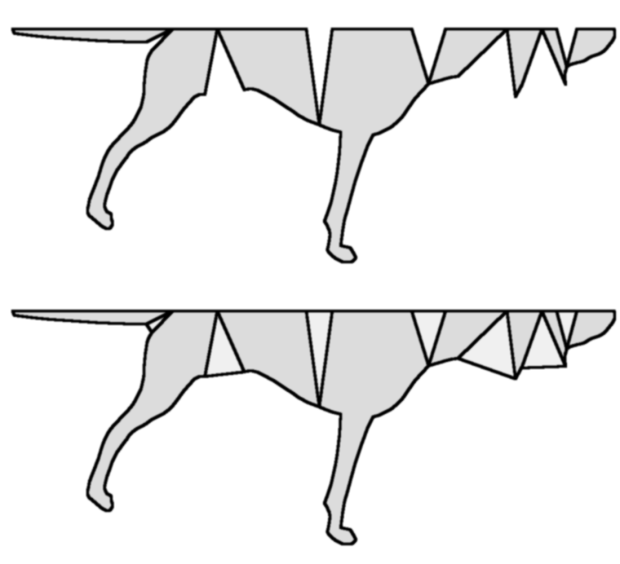
The traced sections (plus the tail) then need to be transferred to
card, such that the spine runs along a single straight line and each
component is just touching its neighbour. The gaps are filled with triangles
as illustrated in the adjacent animation. Each triangle is subsequently
folded in half as well as being folded along its edges.
Create a mirror image of the components you've already drawn. Mark
on all fold lines (shown in the adjacent image as dotted lines) and
create any additional components; such as ears.
Finally you can colour your animal model.
While all of the above operations can be carried out by hand they can
also be performed using a computer graphics package.
Our finished lurcher - the most obedient dog ever witnessed (providing
the only command we give her is stay!)
Note: while this type of model does not require glue for main-body
assembly, a small amount of adhesive along the inside of the spine helps
prevent the animal behaving like Bambi-on-ice.
As with all card models, crease-lines that expose white card can be
enhanced by carefully painting them with watercolour paint.
However you choose to create your model animals we hope you have a
whale of a time; now there's an idea for a card model animal!